|
Osman's Table Tennis Site
The Site Dedicated To Table Tennis!
I have made this site to provide information on the game of Table Tennis. I have added information for people who are biginners to advanced players.
Keep visiting the site as I update it.
|
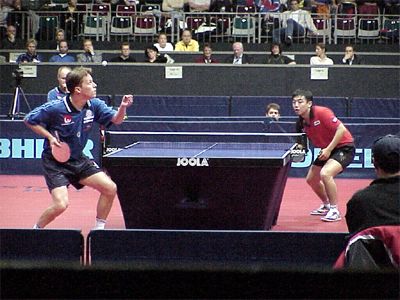
Jan Ove Waldner (Sweden) Serving |
Table Tennis is one of the fastest sport in the world. It is 80% mental strenght aswell as physical and great precision. Playing the sport needs a great deal of concentration.
|
|
Above is a picture of Jan Ove Waldner of Sweden. He is one of the most talented Table Tennis players.
He was the silver medalist in the Sydney olympics(2000).
Notice the intense concentration he has while serving. Serving is a vital part of the game.
|
|
INTRODUCTION
Most of you have played table tennis at some time or other. Most of you have enjoyed your playing! Because it is played indoors and requires relatively little equipment, it is an ideal recreation for everyone. Although it has many similarities with tennis (mainly in the rules), the comparison ends there. The lightness of the ball, the small area of the table, and the time of the response make it a game of great delicacy requiring great agility, lightning responses and of course a high level of physical fitness.
HISTORY
The origin of table tennis has never been exactly pinpointed, even though it's a relatively young sport, younger than lawn tennis and not much older than basketball.
The earliest known form of the sport, called indoor tennis, was played in the early 1880s by British army officers in India and South Africa, using lids from cigar boxes as paddles and rounded corks from wine bottles as balls, with a row of books set up across the middle of a table to form the net.
Other versions developed in England during the 1890s, known variously as "whiff whaff" and "gossima," and Parker Brothers began manufacturing an indoor tennis kit that included a portable net that could be set up on a table, a small ball covered with netting, and miniature paddles.
James Gibb, an Englishman who visited the United States in 1900, brought some hollow celluloid balls home and began playing indoor tennis with friends, using the new balls. Gibb apparently came up with the name "ping pong," representing the sounds of the ball hitting the paddle and then the table.
However, an English manufacturer of sporting goods, John Jacques, registered "Ping Pong" as a trade name in 1901 and sold American rights to Parker Brothers, who came out with a new kit under that name.
Another Englishman, E. C. Goode, in 1902 covered his wooden ping pong paddle with pebbled rubber, which allowed him to put spin on the ball. A Ping Pong Association was founded in England that year, but it lasted less than three years, mainly because Parker Brothers' control of the name made equipment rather expensive.
Nevertheless, the sport spread rather quietly in England and Europe, primarily with equipment marketed by other manufacturers using the generic name of table tennis. A new Table Tennis Association was established in England in 1921. It was followed by the Fédération Internationale de Tennis de Table (International Table Tennis Federation), founded at a 1926 meeting in Berlin by England, Sweden, Hungary, India, Denmark, Germany, Czechoslovakia, Austria, and Wales.
The first world championship tournament was held in London in 1927. From then until World War II, Hungary dominated the sport. The top players of that early period were two Hungarians: Maria Mednyanszky, who won seven women's championships, and Viktor Barna, a five-time men's champion. Czechoslovakia and Romania also produced several champions.
The American Ping Pong Association was organized in 1930, but its membership was limited because only Parker Brothers equipment could be used. Two rival organizations, the U. S. Amateur Table Tennis Association and the National Table Tennis Association, were founded in 1933. The three groups merged in 1935 into the U. S. Table Tennis Association, which was renamed U.S.A. Table Tennis in 1994.
Central European dominance continued for a time after World War II, but Asian players took over the sport beginning in 1953. One factor in the sudden emergence of Asian stars was the introduction of the foam rubber paddle by Japan's Horoi Satoh in1952. The new coating made the game faster and also allowed players to put even more spin in the ball.
Asian players also developed the "penholder" grip, in which the handle of the paddle is held between forefinger and thumb, which allows the player to strike the ball with the same face of the paddle on any stroke..That grip is now used by virtually all top international players.
Table tennis became an Olympic sport in 1988, with singles and doubles competition for both men and women.
send an email

|
|